BEATEN'S COL GADDAFI OFFERS TALKS ON POWER TRANSFER

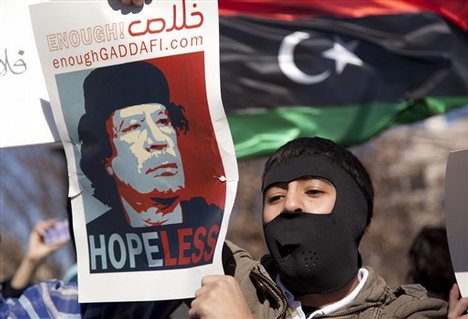 TRIPOLI, Libya - Col Muammar Gaddafi's spokesman told a news agency, Libyan leader is ready to begin talks to transfer power-discussion which would be led by Col Gaddafi's son, Saadi.
Rebel fighters who now control most of the country, including the capital Tripoli, believe Col Gaddafi is still in hiding in the area.
According to BBC, the latest offer will be seen as just another sign of the delusional state of Col Gaddafi and his followers.
 The Libyan opposition says supplies of fuel and water should begin arriving in Tripoli - amid fears that Tripoli's water supply may have been poisoned by Col Gaddafi's forces.
Meanwhile more evidence is emerging of mass killings in the country. More than 50 charred bodies have been found in a burnt out warehouse next to a military base south of the capital.
ELDEST GADDAFI SON GIVES IN TO REBELS

 TRIPOLI, Libya - Libyan opposition forces say the country's dictator Muammar Gaddafi's eldest son Muhammad has surrendered himself to the fighters.
He gave himself up to the revolutionaries in the early hours of Monday after they seized control of Tajura, an eastern suburb of the capital, Tripoli, the Doha-based news channel of Al-Jazeera reported on the Tweeter.
- Muhammad Gaddafi was in charge of the main internet provider service for Libya and cut the country loose from the cyber world immediately after the beginning of a revolution against Gaddafi's regime in February.
- There are also reports that the dictator's security guards have joined the forces.
- Libya has been the scene of intense fighting between government troops and opposition forces since a revolution seeking to topple Gaddafi began in mid-February.
 Libya's former Prime Minister Abdessalam Jalloud, who defected from Gaddafi's regime on Friday, has said that it was too late for the authoritarian ruler to strike a deal to quit power and that he would probably be killed.
"I think it would be difficult for Gaddafi to give himself up...I don't think the evolution of the situation in Tripoli will allow him to survive," he said.
The regime would fall in less than 10 days, said the former official, who was among the officers, who helped Gaddafi wrest power in a coup in 1969, but fell out of favor with the ruler in the nineties.
TRIPOLI UNDER ATTACKS AGAIN

 TRIPOLI, Libya — Nato has carried out its heaviest air strikes against Libya’s capital in more than two months of bombing, amid upbeat comments from France and the United States on progress towards ending Muammar Gaddafi’s rule.
Six loud explosions rocked Tripoli late yesterday within 10 minutes, following powerful strikes 24 hours earlier, including one on Gaddafi’s compound, that Libyan officials said killed 19 people and state television blamed on “colonialist crusaders”.
- French Foreign Minister Alain Juppe said yesterday that the Nato bombing campaign was making progress and should achieve its objectives within months. An alliance official said Tuesday’s early strike was “the most concentrated to date”.
France, Britain and the United States are leading the air strikes, which started on March 19 after the United Nations Security Council authorised “all necessary measures” to protect civilians from Gaddafi’s forces as he sought to crush an uprising against his 41-year rule.
- The three countries have declared they will keep up the campaign until Gaddafi leaves power. Juppe’s upbeat assessment came after the United States said the Libyan leader’s departure was inevitable.
- “There are more and more centres of resistance (to Gaddafi), especially in the west,” Juppe said during a question and answer session in the French parliament. “Defections are speeding up.”
- “I can assure you that our will is to ensure that the mission in Libya does not last longer than a few months.”
 France said this week it would deploy attack helicopters to ensure more precise attacks against Gaddafi forces embedded among the civilian population of Libyan cities. Britain said yesterday it was considering doing the same.
- Military analysts said these plans and the intensified bombing of Tripoli reflected growing Western worries that Libya’s civil war was dragging on indecisively. But they said the new moves may not be enough to tip the balance quickly.

 While critics argue that Nato has overstepped its mandate, rebels have complained Western forces are not doing enough to break Gaddafi’s army.
Gaddafi denies his forces target civilians and says rebels, who control the east of the oil-producing country, are criminals, religious extremists and members of al Qaeda.
LIBYA'S REBEL ASK FOR FINANCIAL SUPPORTS TO FIGHT QADDAFI

 BENGHAZI, LIBYA — Rebel leaders have urged countries that froze Libyan assets to shift that money to them, but diplomats say there are legal obstacles to such a move. A senior U.S. official said the coalition wants to provide financial support to the rebels, but hasn’t committed to a precise amount and is trying to figure out how to do so legally.
On the same token, Libya’s rebel government said Tuesday that it is asking international donors for up to $3 billion in loans, warning that without the cash infusion it will be unable to pay the salaries of civil servants and provide food and medicine to civilians.
 Top diplomats from around the world, including Secretary of State Hillary Rodham Clinton, are scheduled to discuss ways to meet the financial needs of the rebels at a meeting in Rome on Thursday.
- After more than two months of fighting, the economy in the eastern portion of the country has been badly battered. While most of the country’s oil comes from the east, forces loyal to Libyan leader Moammar Gaddafi have disrupted production, denying the rebels a potential lifeline. The effective partitioning of the country interrupted pay for the majority of workers here, who are employed in the public sector and were paid from Tripoli before the fighting began.
 Until now, rebels had, for the most part, managed to keep those salaries coming. But, they warned, money is running out.
- Ali Tarhouni, the rebels’ interim finance minister, told reporters in the de facto capital of the rebel-held east that the Benghazi government has only enough to carry it through “three weeks, at the most four weeks.”


 The senior U.S. official, who was not authorized to speak on the record and so talked on the condition of anonymity, said it was unclear how the Libyan rebels had come up with the figure of $2 billion to $3 billion. “I think we have to wait and see what the breakdown is, or how and why they’re asking for that particular figure” before deciding if it’s an accurate reflection of their needs, he said.
- The official said that “there’s a whole gamut of options people are looking at” to provide financial assistance without violating U.N. sanctions or their countries’ own laws. It was not yet clear whether one mechanism would be chosen when the United States and other allies in the Libya Contact Group meet Thursday, he said.
- The rebels’ proposal that they receive frozen assets belonging to Gaddafi and his government presents legal hurdles for some countries, especially those, like the United States, that haven’t recognized the Transitional National Council, the self-appointed rebel authority, as Libya’s new government. In recognition of those obstacles, some European diplomats have floated the idea of creating a trust fund for the rebels, which would be repaid once a new Libyan government is established and oil revenues are flowing again.
LIBYAN SITUATION CANNOT BE RESOLVED MILITARILY?


 BEIJING, China - The crisis in Libya cannot be resolved militarily, Germany's foreign minister said in Beijing on Friday, calling for efforts for a political solution for the oil-rich North African nation, as human rights organizations report over 400 people missing.
Germany broke ranks with the United States, France and Britain and joined China, Russia, India and Brazil in abstaining on a United Nations vote authorising the use of force to enforce a no-fly zone over Libya and protect civilians.
 "The Libyan situation cannot be resolved by military means," Guido Westerwelle told reporters after meeting his Chinese counterpart Yang Jiechi, according to a pool report.
- "There can only be a political resolution and we must get the political process under way. That should begin with a ceasefire that Gaddafi must heed to allow the peace process to begin," he said.
- Westerwelle said at an EU foreign ministers' meeting last month that Arab League criticism of the air strikes had vindicated Germany's reluctance to back the action.
 Berlin had long said it did not believe a no-fly zone or air strikes would be successful in driving Libyan leader Muammar Gaddafi out or protecting Libyan civilians.
- Westerwelle has dismissed claims that Berlin was isolated after refusing to join its NATO allies in staging military strikes on Libya.


 German Chancellor Angela Merkel's decision to opt out of any military action in Libya has drawn criticism at home, putting the government on the defensive over a policy that opinion polls suggest should be popular with voters.
QADDAFI'S FORCES PLACED CORPES AT THE COALITION BOMBED SITES?

 WASHINGTON, U.S.A. - U.S. intelligence reports suggest that Libyan leader Muammar Qaddafi's forces have placed the bodies of people they have killed at the sites of coalition air strikes so they can blame the West for the deaths, U.S. Secretary of Defense Robert Gates said in a television interview on Saturday.
"We do have a lot of intelligence reporting about Gaddafi taking the bodies of the people he's killed and putting them at the sites where we've attacked," Gates said according to interview excerpts released by CBS News' "Face the Nation with Bob Schieffer" program, which will air on Sunday.
 A U.S.-led coalition began air strikes against Libya a week ago to establish a no-fly zone over the oil-exporting North African country and to try to prevent Gaddafi from using his air force to attack people rebelling against his rule.
- Last week Libyan officials said nearly 100 civilians had been killed in the coalition strikes, but Western military officials at the time denied any civilians had been killed.
- "The truth of the matter is we have trouble coming up with proof of any civilian casualties that we have been responsible for," Gates said in the television interview.

 Separately, the State Department praised the African Union for convening a meeting on Libya and said the group had an important role to play in resolving the crisis there.

VISITORS GEOFLAGS SINCE AUGUST 26, 2009